
Melanie Bruder PgCertSART, DipCOT, PgCert(Dist), HCPC, MIRVAP
We are thrilled to welcome Mel to the Therapists’ Blog. She is both a friend and an outstanding canine clinician. As a quiet, reflective, and deeply caring professional, she has become an established influencer in the UK canine therapy industry.
Mel is widely recognised as the leading canine splinting specialist and the “go-to person” for clinical advice in this field.
With a professional background as a paediatric occupational therapist (OT) specialising in hand therapy, Mel successfully achieved her postgraduate status at the School of Veterinary Medicine and Science at the University of Nottingham, qualifying as a level 7 small animal Veterinary Physiotherapist.
It was a natural progression for her to expand her established splinting and orthotic expertise to include dogs and small animals.
Fourteen years on, canine splinting now forms 45% of Mel’s clinical caseload. She also shares her knowledge as a guest lecturer on this specialist topic at UK universities and colleges.
I highly value her willingness to share her clinical skills and am delighted to feature her insights below.
The Therapeutic Approach to Canine Splints
Words by Mel Bruder:
I believe that the ability to assess for, design, and fit custom splints is a very useful addition to each Veterinary Physiotherapist’s individual therapeutic clinical skills toolbox.
Canine splint-making requires specific skills in design and material handling, as well as a detailed knowledge of canine functional anatomy and biomechanics.
It’s important to note that the potential to do harm is real if splints are applied incorrectly.
Having said that, the satisfaction of seeing a dog walk with a digitigrade stance after a calcaneal tendon rupture is immense!
Splints literally can be a game changer for the right canine patient. Patients are referred to me from a variety of sources, including referral hospitals, general practice vets, and other therapists.
Splints may be part of a rehabilitation process, for example, serially splinting out a contracture. In many instances, they offer a vital compromise for dogs who are unsuitable for surgery.
I use a combination of neoprene, low-temperature thermoplastics, and more recently, I am exploring the option to scan for Wimba splints.
Carpal and hock splints are the most common requests I receive, but I have also designed more complex cervical and spinal splints.
Principles of “Off the Shelf” Splints
I am often asked about “off the shelf” splints. If you are considering these, there are several basic principles to consider:
Firstly, the splint should sit approximately two-thirds of the length of the long bone above and below the joint you are splinting.
It must fit snugly, but never tightly. If the splint is hinged, it needs to sit exactly at the point of motion of the joint so it does not slip or twist.
Finally, the skin needs to be monitored very closely for any signs of pressure or abrasion.
NB. If you do not think your owner client will do this reliably, do not fit a splint.
Canine Case Examples
These case summaries highlight how useful splinting can be, whilst also helping us understand the limitations.
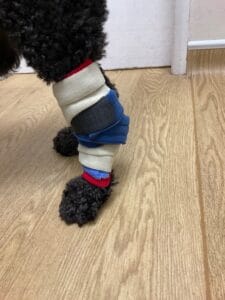
Case 1: 10-year-old male Labradoodle presented with achilles tendinitis.

The left image shows typical hyperflexion at the hock and was off-loading the hindlimb. The splintage aims to extend the hock, taking the stress off the tendon and allowing it to heal. This treatment strategy is often combined with other therapies, including LASER therapy. The splint is usually worn for 6 to 8 weeks, and potentially longer if there is significant damage to the tendon complex.
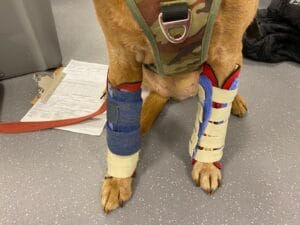
Case 2: 12-year-old female Labrador Retriever sustained bilateral carpal fractures after falling.
Bilateral carpal fractures after falling off a cliff in Derbyshire. A pancarpal arthrodesis was performed on one leg, and I provided splintage for the less severely affected leg.
Unfortunately, about a year later, the surgical plates had to be removed due to infection. This dog was managed for several years in these carpal splints. The splints were reviewed regularly and re-padded when required to ensure a comfortable fit.
Case 3: 14-year-old male Border Collie with an aggressive bone tumour diagnosis.

An aggressive bone tumour was diagnosed which affected the carpal joint. He had significant collapse in the joint but was otherwise well and had very good pain control in place.
The splint gave him about six months of help mobilising. On reflection, the splint required careful monitoring by his very dedicated owners, alongside several adjustments as the tumour changed.
Advancing your Clinical Skills
Mel Bruder asks:
Do you have any questions on canine splint-making?
She provides an ongoing advice service. Videos are always helpful when submitting an enquiry.
NB. Please be aware it takes time to review and answer each case.
Mel also delivers courses covering fundamental topics, including neoprene splints and the use of low-temperature thermoplastics, tailored to your experience level.
Making neoprene splints is a very good place to start for Veterinary Physiotherapists wanting to offer an additional service, as these core skills are relatively straightforward to acquire.
For further information:
Please contact Mel by email at melbruder@uwclub.net or visit her website at Phoenix Veterinary Physiotherapy.
Advance Your Clinical Practice
Ready to progress your clinical practice? Join a global community of canine professionals in the K9 Therapy Hub for evidence-based CPD, clinical resources and peer support.