Canine Movement Enrichment is so much more than just a group of techniques and strategies. It’s a complete system of clinical practice designed to build a trusted, mindful bond with each dog, empowering the therapist to interact and work with their canine client in a deeply connected and active way.
When I first introduced Canine Therapeutic Handling into the Royal Veterinary College’s Masters programme in Veterinary Physiotherapy in 2003, it was transformational to canine clinical practice. These clinical proven techniques empower the therapist and ensures the dog has choices, as well as being very highly proprioceptively enriched.
They replaced general animal handling, coercion with training tactics and restraint holds, for example a therapsit sitting on the ground with their leg over the dog to keep it in lying.
My passion has been helping dogs to be happy, healthy and enjoy their life to the full.
Integrating Therapeutic Handling into clinical practice – including clinical hydrotherapy, physiotherapy and rehabilitation – has influenced all my choices.
Today, K9HS Courses is an established online Canine CPD provider and these proprietary techniques are taught to canine therapists worldwide.
Working With the Dog, Not On the Dog
A pivotal moment in my career happened in 1980 when an eminent human physiotherapist shared a piece of wisdom that changed my practice forever:
“Therapeutic Touch is a two-way process.”
Transitioning from human practice to working full time with dogs in the mid-nineties, I realised that Therapeutic Handling is so much more than a stream of information between my hands and the dog’s tissues. The therapeutic connection it created between me and each of my canine patients was humbling.
I believe that gaining the trust, confidence and consent of each dog is paramount. Building this professional bond empowers the therapist to gain the dog’s active participation. This leads to a much higher proprioceptive rating value of the session as the dog is working in their concious level. This results in excellent clinical outcomes compared to the historic approach.
A two-year clinical audit of 457 canine owner clients revealed something astonishing: the top factors our clients valued most were our Therapeutic Handling techniques above all else. This evidenced just how vital these proprioceptively enriched techniques are, both clinically and from a business perspective.
The Canine Biomechanical Design
“At the core of effective Therapeutic Handling techniques is a renewed focus on canine biomechanics and how dogs naturally choose to balance and move.”
Dogs have a specific quadrupedal biomechanical design and a digitigrade stance. Movement is organised in sequences to achieve specific daily functional activities, such as standing balance, toileting, rising after rest and changing posture.
Dogs organise their movement very differently to humans, which is why they require specific canine assessment and treatment techniques.
The dog is biomechanically designed to predominatly go forwards in the sagittal plane. We know that backward movement is not a natural canine motion pattern and puts the dog’s biomechanical system under severe duress.
Using a car analogy, a car is designed to primarily drive forwards; reversing is a limited supplementary manoeuvre.
Therapists need to work within the biological design of th dog, to limit unwanted forces and prevent undesired consequences.
Breed Differences in Motion
Within this fantastic species, what is considered normal motion for one breed may be abnormal motion in another.
For example, Border Collies have low-angled hocks that allow them to turn quickly and creep to help herd. In contrast, the Greyhound is the canine elite sprint athlete with long parallel legs and a double suspension rotary racing gallop. Low-angled hocks would be considered a serious conformational flaw in a Greyhound.
Understanding normal canine balance and motion empowers the therapist to make informed treatment choices aimed at significantly improving canine movement dysfunction, fitness levels and functional abilities.
The Power of Eccentric Muscle Contraction
As we explore in detail in our Therapist Blog: Canine Muscle Injuries, the facts are that eccentric contraction has a higher power output compared to concentric contractions.
Because we know clinically that canine movement consists mainly of eccentric muscle contraction work, it’s essential to incorporate isometric exercise into all canine treatment programmes, dynamically balancing closed-chain and open-chain kinetic exercise.
Understanding this physiological fact is the foundation of why Therapeutic Handling techniques are so effective at rebuilding safe, powerful and efficient motion.
Canine Therapeutic Handling Toolbox
Canine Therapeutic Handling techniques encompass a complete therapeutic approach focused on improving canine movement. The K9HS framework includes:
- Therapeutic Holds (with Canine Key Points of Control – KPC)
- Therapeutic Lifts
- Therapeutic Touch
- Movement Shaping (Terra and Aquatic)
- Proprioceptive Paw Placement (PPP) techniques
- Visual Indicators
- Clinical Intention techniques
Canine Therapeutic Touch is where every single touch is considered, clinically relevant and mindful. For instance, using the sternum which is a canine Therapeutic Key Point of Control, can significantly positively impact the dog’s natural balance, posture and motion.
FACT: Key Points of Control are not just “brake points” to movement; they are “control motion points” of entire movement sequences.
Clinic Enrichment: The Missing Link
Canine Movement Enrichment techniques consist of both Therapeutic Handling techniques and Clinic Enrichment strategies.
Clinic Enrichment is how you use the clinic space and the moment-by-moment decisions of your own body posture choices.
There is often a mismatch across our species: dogs mainly use body posturing and facial expressions (a continuous stream of calming signals), whereas humans rely heavily on spoken language.
By observing, understanding and responding to these feedback signals appropriately in real-time, you can guide the dog’s choices and decisions to work actively “with” you using their conscious level of proprioception, rather than their automated unconscious level.
The Art of the Initial Touch
Being successful in canine therapy requires a combination of science-based knowledge linked to the art of making effective clinical judgements.
“How do you introduce that important first touch with the dog in your clinic?”
Therapeutic Touch is an invaluable flexible tool. Initial touch can be direct, or it could be indirect, utilising a technique such as therapeutic lead stroking.
With Therapeutic Handling techniques, we can use therapeutic lead stroking symmetrically, asymmetrically, double-leaded or single-leaded.
This therapeutic connection through a piece of equipment the dog is familiar with converts the approach into a high proprioceptive-rated activity by raising the dog’s body awareness and working in their conscious level.
Using a facilitatory upward sweep touch on the underside of the lead, linked to your own controlled rhythmical body postural transfers, positively influences the dog’s behaviours. It can be deeply calming and positively influence both the dog’s natural balanced stance and the directional motion choices the therapist directs.
(Note: We demonstrate this exact technique step-by-step in our unique K9TV instructional videos within our Therapeutic Handling Techniques and Therapeutic Lead Techniques CPD courses).
Rethinking Restraint: The Manubrium KPC
“Humans often use a lead connected to a collar. However, the canine neck is a powerful Key Point of Control that can easily take the dog out of balance when accidently misused.”
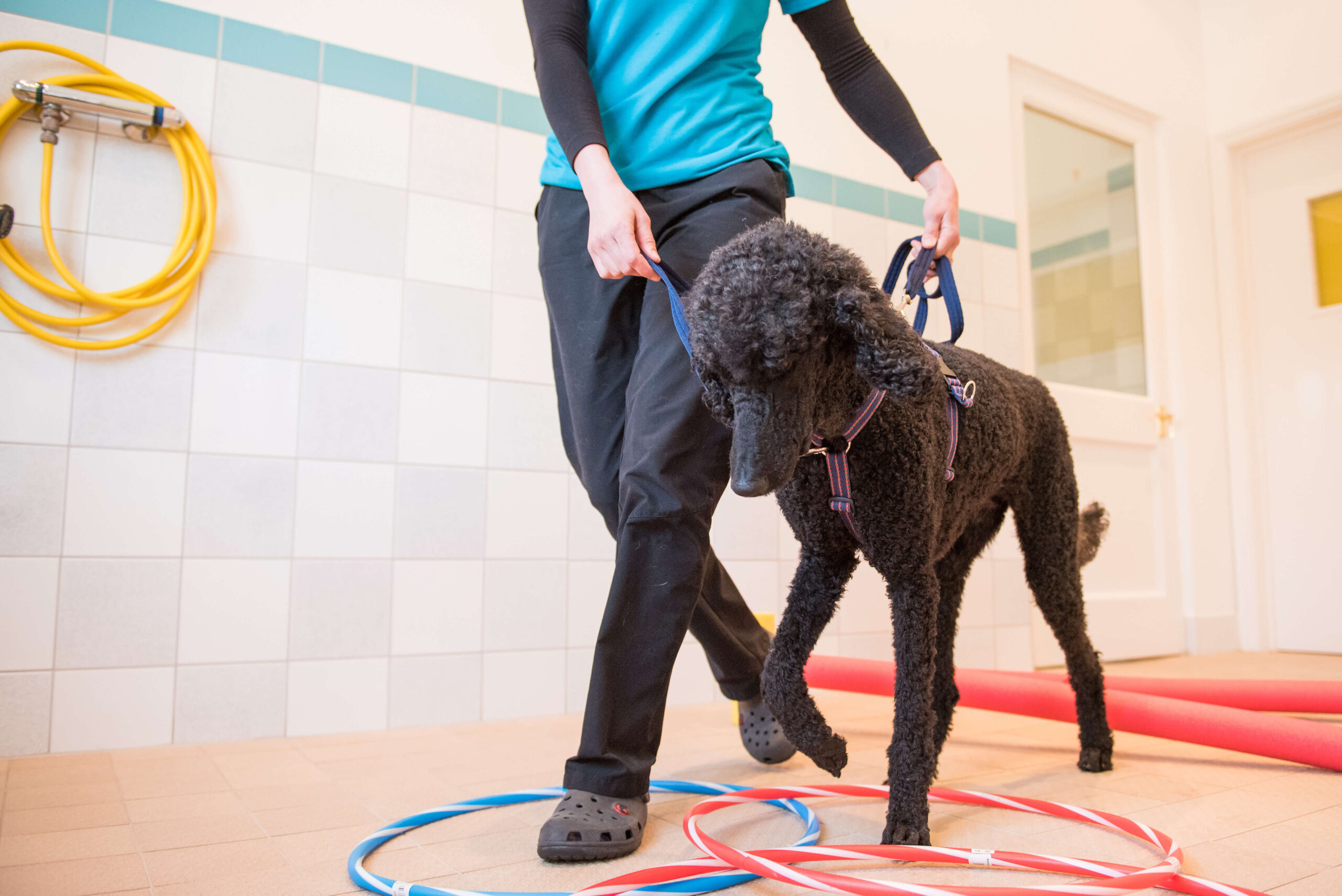
Canine therapists opt for Therapeutic Holds that influence and control the dog’s core rather than the neck and head, creating a neutral and comfortable natural balanced posture.
The canine manubrium (at the top of the sternum or chest bone) is an incredibly important canine Key Point of Control. It acts as a sternal handbrake to the dog’s movement, but it is also a fantastic dynamic motion point.
Using a well-fitted Y-shaped harness combined with Therapeutic Handling assists the dog to move efficiently in their natural balanced motion, transforming an everyday activity into a high-rated proprioceptive enriched experience.
(Note: We demonstrate this within our Therapeutic Handling Techniques and Therapeutic Y- Harness CPD courses).
The Neurology of Canine Motion: Understanding CPGs
Central Pattern Generators (CPGs) are neural circuits found in both humans and dogs. However, humans have much fewer CPGs compared to dogs.
FACT: Humans organise their movement sequences predominantly using their pyramidal pathway system. Dogs, on the other hand, have large numbers of CPGs in their thoracic and lumbar spine and mainly use their extra-pyramidal pathway. This increased number of canine CPGs supports the canine design of motion automation at the spinal level.
CPGs give out a rhythmic output and are the drivers of canine gait and canine swimming.
Canine motion is driven by the equation: CPGs = Proprioceptive System x Muscle.
Because motion is initiated, controlled and orchestrated by the proprioceptive system, therapists can positively influence it using Therapeutic Handling techniques and Clinical Enrichment approaches.
Canine Movement Enrichment techniques have a high proprioceptive rating, are completely species-specific and are extremely relevant to canine function.
Achieving Active Participation
How can we use Therapeutic Handling techniques to help a nervous dog enter the hydro pool for the first time?
We use our body posturing and our understanding of clinical motivators to assist the dog to move in balance. Building a professional bond of trust leads to an active decision by the dog to follow the therapist’s guidance. Finding therapeutic solutions to help the dog cope with the difficult challenge of entering a new environment is the true art of canine therapy.
We know clinically that if a dog chooses to actively participate (making a conscious, mediated decision of active motion), this holds a very high proprioceptive rating value and will significantly improve their movement quality.
This therapeutic bond of professional trust between the therapist and dog is truly amazing, and it is exactly why I love my job so much. Seeing positive changes in behaviour, posture, balance and motion within a single session is endlessly inspiring.
Advancing Your Clinical Excellence
A dog moving in natural balance on land or in water will move efficiently and with engaged power. Injury and dysfunction cause the dog to move out of balance, leading to inefficient secondary movement patterns.
By using specific species knowledge, therapists can make informed, highly effective treatment choices to achieve long-term benefits.
I have spent decades developing and refining these techniques, drawing heavily on my early training in the Feldenkrais Method, Alexander techniques, Neourdevelopmental techniques and therapeutic Pilates, adapting those profound biomechanical truths for the canine form.
As professionals, canine therapists are committed to working within their scope of practice and embracing the reality that there is always something new to learn.
These proven clinical techniques achieve extraordinary results and significantly improve the lives of both dogs and owners.
Advancing your knowledge and skills further in Canine Movement Enrichment Techniques will fundamentally progress the quality and success of your service and your business.
Produced, owned and copyright to Barbara Houlding – K9HS Courses. All Rights Reserved.
These techniques were pioneered and introduced into the canine veterinary physiotherapy and clinical hydrotherapy industry by Barbara Houlding / K9HS Courses.
Advance Your Clinical Practice
Ready to progress your clinical practice? Join a global community of canine professionals in the K9 Therapy Hub for evidence-based CPD, clinical resources and peer support.